Scars after plastic surgery – what can you expect?
 Frequently asked questions about scars after plastic surgery
 Frequently asked questions about scars after plastic surgery
How long does it take for a scar to fade?
Most scars mature over 12-18 months. After that, many scars continue to improve and fade gradually. In some cases, scar healing can take even longer depending on individual factors and the location of the scar.
Can scars be completely removed?
No. All surgical incisions leave some form of scar. However, with modern plastic surgery and proper scar treatment, we can create good conditions for the scar to be as discreet as possible.
Does laser help with scars?
Yes. Laser scar treatment can reduce redness, improve skin texture, and make the scar less prominent. However, the best laser for you will depend on the appearance and maturity of the scar.
This is how we create the best possible conditions for a nice scar
One of the most common questions before a plastic surgery operation is:
“Will I get a scar?”
The answer is simple: Yes. All surgical procedures that involve an incision in the skin leave some form of scar. However, there is much we can do to optimize healing and create the best possible conditions for the scar to be narrow, flat, pale and discreet.
How a scar develops after surgery is influenced by several factors:
- Surgeon's technique
- The location of the scar on the body
- Stress and tension in the skin
- Individual and genetic conditions
- Aftercare and scar treatment
The goal is not to promise an invisible scar. Instead, we strive to give each patient the best possible conditions for a beautifully healed result.
A beautiful scar begins during surgery
The foundation for good scar healing is already laid in the operating room.
Surgical precision is not only about placing the incision in the right place, but also about handling the tissue as gently as possible. In addition, wound closure plays a crucial role in the final outcome.
When we suture the wound in several layers, we can distribute the tension in the deeper tissues instead of putting direct stress on the skin. This reduces the risk of the scar becoming wide or stretched.
This is a central principle in modern plastic surgery and preventive scar treatment.
Why do some scars heal better than others?
All areas of the body have different conditions for healing.
For example, surgical scars on the face often heal very well thanks to good blood circulation and relatively low stress on the skin.
In areas such as:
- The sternum
- The shoulders
- Upper back
- The chest
However, there is a greater risk that scars will become red, wide or raised.
At the same time, genetic factors play an important role, which is why two people who undergo the exact same surgery can have completely different scar results.
How does scar healing occur after surgery?
The inflammation phase
Immediately after surgery, the body's natural wound healing process starts.
During this first phase:
- The body stops the bleeding
- The body clears away bacteria and damaged tissue
- The repair process begins
It is therefore important to follow our instructions regarding wound care, showering and hygiene to reduce the risk of complications.
The proliferation phase
After a few weeks, the body begins to form new collagen.
During this period, it is common for the scar to become:
- RED
- Fast
- Thicker
- Something elevated
This does not normally mean that something has gone wrong. On the contrary, this is a natural part of the body's healing process.
The maturation phase
After that, the healing enters the maturation phase.
During this period, the body gradually reorganizes the collagen. As a result, the scar usually becomes:
- Softer
- Flatter
- Bleacher
This process can last 12-18 months and sometimes even longer.
Taping and silicone treatment of scars
Once the wound has healed sufficiently, we often begin active scar treatment.
Scar taping
Tape, such as Micropore, can help to:
- Reduce skin traction
- Relieve the scar
- Improve healing conditions
Silicone tape and silicone gel
In addition, we often use silicone-based products for scar treatment.
Silicone treatment is one of the most well-documented methods for preventing and treating hypertrophic scars.
The benefits include that silicone can:
- Reduce redness
- Reduce raised scars
- Help the skin maintain the correct moisture balance
- Improve scar structure over time
We adapt the choice between tape and silicone individually based on the type of surgery, skin type and how healing progresses.
When should a problematic scar be treated?
In the past, people often waited until the scar had fully matured before starting treatment.
Today, however, we know that early action often yields better results.
Signs that a scar should be evaluated include:
- Severe redness
- Itching
- Pain
- Thickening
- Raised areas
- Continued active scar growth
If these symptoms occur, we can, for example, treat the scar with cortisone injections, laser or other modern treatment methods.
Laser treatment of scars – a modern and effective method
Laser treatment has become an important tool in modern scar treatment.
We use different types of lasers depending on the problems we want to treat.
Vascular lasers
Vascular lasers primarily help to:
- Reduce redness
- Treat visible blood vessels
- Calm active scars
Fractional laser
Fractional laser can:
- Improve skin texture
- Reduce unevenness
- Stimulate new collagen formation
- Improve scar quality
We always adapt the laser treatment to the appearance of the scar, its maturity and the patient's individual conditions.
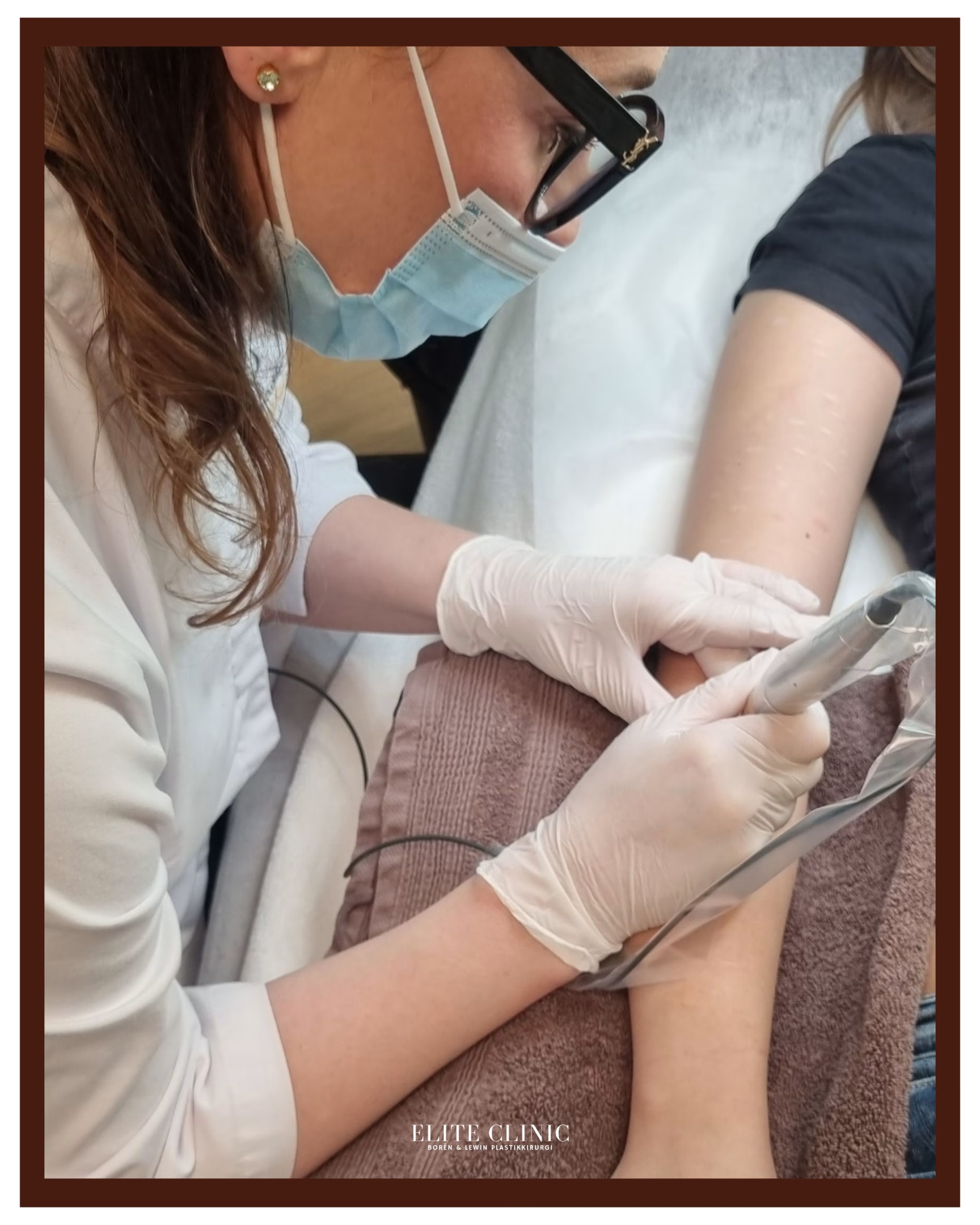
Microneedling for scars
In selected cases, we use microneedling to improve the skin's structure and stimulate the body's natural healing process.
The treatment is mainly suitable for:
- Irregular scars
- Structural skin changes
- Improvement of skin quality after healing
At the same time, the right timing is crucial to achieving the best possible results.
Medical tattooing and scar camouflage
Even a well-healed scar can sometimes be lighter than the surrounding skin.
When the scar is fully mature, usually after a year or more, medical tattooing or scar camouflage may be an option.
By matching the area to the surrounding skin color, we can:
- Reduce visible color differences
- Make the scar less prominent
- Further improve the cosmetic result
This does not affect the healing itself but serves as a final aesthetic step when the scar is stable.
Our philosophy regarding scar treatment after plastic surgery
We do not view scar treatment as a single measure. Instead, we view it as a process that begins even before surgery and continues throughout the healing process.
Our treatment strategy
Careful surgery → Unloaded suturing → Individual wound care → Tape or silicone → Regular follow-up → Laser treatment if necessary → Medical tattooing when the scar is fully mature
We can never guarantee that a scar will be completely invisible. However, through experienced surgical technique, modern scar treatment and careful follow-up, we can give each scar the best possible chance to become flat, pale and discreet.